


Real races continue to happen as timers lead our industry into the “new normal”. This past weekend, the Social Distance 5K provided a truly competitive racing experience for the participants while adhering to all local and state regulations and CDC social distancing and safety guidelines. Please note that all states and communities have different reopening plans, so what worked for this race in Indiana may not be applicable given your local guidelines at this time.
Here is a quick overview:
- 220 participants
- Rolling start from 6am to 9am using corrals as time slots
- 14 people every 10 minutes, and never more than 1 person at the start line at a time
- Held in a local park
- 2 CheckIn stations with plexiglass barriers
- No finisher medals or aid stations – the goal was to provide a race with zero contact
Thanks to Todd Henderlong of T & H Timing for putting on a successful race with proper social distancing, and for providing us photos and notes on how it went. You can reach out to him via his contact page if you have questions.



Permit
Getting a permit was the most complicated and frustrating part of putting on a race in the “new normal”. Todd developed a plan to execute a race with social distancing when the pandemic first hit. As restrictions started gradually lifting, allowing groups to gather and golf courses to reopen, Todd started reaching out to local municipalities to see if he could do a race at one of the local golf courses where there could be a closed course.
He went through weeks of getting permits and then having them pulled. Local authorities would think it was a great idea – races are healthy, outdoors, and Todd’s plan ensured social distancing – but then someone would get nervous and pull the permit.
Todd’s worked with the local Parks Department throughout the years; traditionally, their race is one of the biggest in town and Todd makes them look good every year by helping them execute a great race experience. They too initially approved the permit for the race. Then someone got wind of it and the permit was revoked. The same day they revoked the permit, the Parks Department opened golf courses and at the state level, restaurants and stores were opening. Todd made the point that a race was safer than golfing (people spread out more, no contact like you have with golf carts) – and if golfing was allowed, why not a race?
Todd got the permit the week before the race. The guy who was most opposed attended the race to observe. He was impressed with the set up and the event. That means the permit process will be easier next time.
Key Takeaways
- Create a plan for a race with social distancing, even if your state hasn’t started to re-open yet. Use the Looking Forward Guidelines as a starting place for ideas (you can download it and make it your own). When you start applying for permits you need to be prepared with a plan.
- Maintain and build your relationships with local permitting officials. When you are able to have a race, invite them to attend and observe so that they can feel comfortable and confident that your race is a safe event with proper social distancing.
- Use benchmarks. Todd used golf courses re-opening as a benchmark for a 220 person race on a closed course.
Course
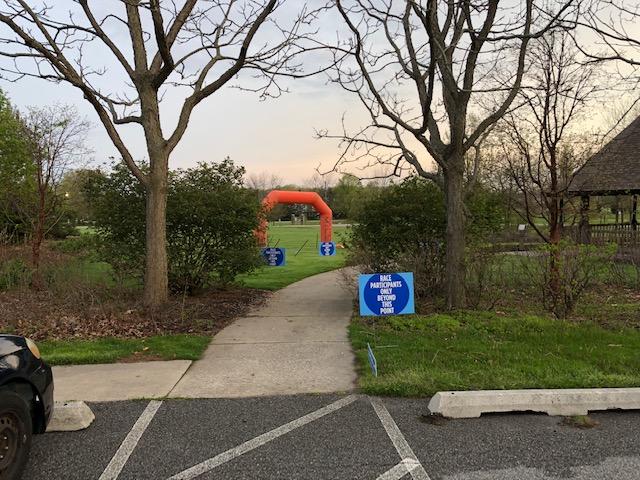
The race was held at a park because it’s a closed course. With rolling starts that take hours, you can’t keep roads closed for that long.
Corrals
Todd used RunSignup’s flexible corrals as time slots for when people could sign up to start. With RunSignup’s corrals, you can limit each time slot to a certain number of people. He told people to show up 15 minutes ahead of their chosen time slot, and they were able to start the race anytime in that window.
The corrals were set up to allow 14 people every 10 minutes. Initially the time slots were from 7am-9am, but with a lot of interest in the race he added an additional one from 6am-7am – although not many people came out between 6 and 7.
The other factor with corral size was parking. There were 110 parking spots in this park. The slowest participants finish a 5k in an hour, and since there wasn’t any post-race activity people wouldn’t stay much more than an hour.
Key Takeaways
- Start small, then scale. For this first race, the rolling start was really spread out because Todd wanted to be overly cautious with each part of the race. For the next race, and as restrictions continue to be less strict, he will probably increase to 25 people every 10 minutes.
- Use corrals to space people out. You can let people choose their own time slots like Todd did. Or assign people corrals/starting times ahead of the race, potentially by age groups, alphabetically, or speed.
- Consider limiting factors like parking. You want to make sure that there is no risk of crowds, so factor in things like parking when setting up corrals.
CheckIn and RaceDay
Todd built plexiglass screens for checking people in safely and ensuring no contact. They are collapsible so he can re-use them for other races.
For this race, they closed registration at 6am the morning of the race. In the future, they will keep it open so that people can sign up at home or from their phones the day of the race. But they will no longer offer onsite registration – it’s an easy thing to eliminate and everyone is more comfortable using their own device rather than touching a shared screen.
They did 2 days of packet pick up at the running store. They still had about 100 people to check in on race day at the course. They had 2 CheckIn stations that T & H Timing staff worked (not volunteers). They used the CheckIn App for a contactless experience. Since participants were starting over a period of 3 hours, there was never more than one person checking in at a time. But the set up was similar to the checkout lines in grocery stores, with 6 foot markings for social distance, and one way flow of movement.
Timing
Todd uses The Race Director to time races. They had a separate start and finish, although he talked through gap factors with Roger Bradshaw ahead of time, which they may use if they want to enforce divisions moving forward. Some other timers are using gap factors because they have the same start and finish, like Crisp using RaceDay Scoring for his neighborhood 5ks.
Todd also set up a leaderboard so that people wouldn’t come up to him for their times. Publicly displaying finishers, along with text results when they cross the finish line, ensure that there aren’t crowds or groups of people lingering after they finish the race.
Volunteers
T & H Timing has a staff, and that’s who worked this race. With a low-frills set up, the need for volunteers is dramatically reduced – no aid stations, no shirt pick up, no post-race food/party.
Volunteers may be used out along the course to help point directions. Since that is a job with social distancing and no contact, it will be easy to find volunteers.
The Next Races
Todd has several postponed races. He is working to change their venue (from roads to parks) and put on similar style events, as well as other races. Here are some of the things he will do moving forward:
- 400-500 participants (Indiana is reopening quickly, and will soon allow groups of 250)
- Will offer live and virtual events for every race (virtual is here to stay)
- Rolling start between 7am and 10am – most people won’t come out as early as 6am, so it would be best to work with the venue to have a slightly later cutoff time.
- Corrals/time slots
- 25 people every 10 minutes
- Several options for how to structure the corrals
- Age group – can compete against each other, but families with different ages end up staying at the course too long
- Alphabetical – families can run together – this seems like the best grouping (and families with different last names can “cheat” to start together)
- Estimated time – difficult to truly validate, and families with different paces may end up hanging around the course and parking lot too long
- Finisher medals – they didn’t offer them at this race to keep it 100% contactless, but people like medals and they will probably have them at future races.
- Todd is planning on building a board with pegs, hang the medals up so that they are spaced out and finishers can grab and go.
- The board will also be collapsible so that it can be transported and re-used.
Races will look different in the weeks and months to come, but technology and creativity are letting us get back to racing in a way that complies with social distancing and local and state guidelines.